Sphinx poetry reviews

April 11th, 2010

Four new reviews of recent poetry pamphlets in Sphinx 12:

  • Peter Sansom, The Night Is Young (Rialto, 2009)
  • Andrew McMillan, Every Salt Advance (Red Squirrel Press, 2009)
  • Lyn Moir, Easterly Force 10 (Calder Wood Press, 2009)
  • Michael Davenport, Tell Me about Them (Tyne and Esk Writers, 2009)

Sphinx reviews focus on poetry pamphlets (also known as chapbooks), and has hit upon the brilliant idea of commissioning three reviews for every pamphlet featured, so you get two other perspectives on each of these books alongside my own. There are also plenty of other reviews to browse.

Volcano Trip (Fimmvörðuháls)

April 5th, 2010

Last week two of us decided to go and see the volcano at Fimmvörðuháls in southern Iceland before it was too late. It began erupting around 21 March, and on Thursday last week reports were coming in that it was beginning to die down. But then that same evening a new fissure opened up, renewing the flow of lava.

Now the walk from Skógafoss up to Fimmvörðuháls and down the other side into the lush and wonderful valley of Þórsmörk is one that I’ve been wanting to do ever since I visited Þórsmörk last summer, but it’s not a walk you would ordinarily do at the start of April. Fimmvörðuháls is a watershed lying over 1000m up in between two glaciers, Eyjafjallajökull and Mýrdalsjökull. The weather can be very changeable, large sections of the route are liable to be snowed over, and it can be bitterly cold. I have heard that it has reached -30C up there in the last couple of weeks, and that several walkers have come down with hypothermia.

Photo of Fimmvörðuháls eruption seen from Route 1

Fimmvörðuháls eruption seen from Route 1


It was cold. The roadside thermometers en route read -9C and I had to wear two woolly hats and a hood to keep my head warm. Without the hood, the wind just blasted through. I felt like an Arctic explorer, with just a small patch of skin exposed around the nose, which ended up getting super chilled and sunburnt at the same time.

The walk began at Skógafoss, an impressive waterfall known for its perma-rainbow (so long as the sun is shining). In the summer I’d tried to get as close to the rainbow as I could; the closer I had got, the more the rainbow had shrunk, until its arc had become a full circle just a metre or two from my hands. At that proximity to the falls, you feel like you’re being battered by shock waves as the force of water slamming into the pool at the bottom sends pulses of spray and water radiating outwards.

I got drenched, of course, but that was the summer. This time we made straight for the steps up beside the waterfall, which are a good warm-up for the walk to come. Above Skógafoss, the path climbs continuously but gently, following the river Skógá as it runs through ravines, around rocky outcrops, and over dozens of waterfalls. Several times the path splits, but the branches always re-join, so you can’t go wrong. The left branches usually pass closer to the river—more picturesque, but sometimes also involving precipitous scrambles.

In spite of the cold, the sun was bright and the sky absolutely clear, so we had fantastic views looking back down the mountainside towards the ocean, with flat farmlands and black sands in between. The river was often marked by a dark gash of canyon, and on the right the massive but diminishing pyramid shape of Raufarfell showed how far we had come.

photo of snowy overhang in a gully - snowboard heaven!

snowboard heaven


Many of the waterfalls were frozen over, and overhangs in the canyon walls were dashed with giant icicles. Smoothly formed features in the upper rock strata that must have been formed by fluvial erosion gave us a sense of geological change, how the river must once have flowed much higher up in the canyon.

The river itself was frozen over in many places, with dark channels where the water still flowed freely marking the thalweg, the place where the current is strongest. Sometimes the shapes formed by the ice seemed to pick up the spiralling patterns of eddies, especially at turns and narrow points, and once or twice I spotted what looked like fast-forming ox-bow lakes, where the water must have been blocked off, only to push through another course.

After three hours or so, at about 550m, we came to the snowline, where it might ordinarily have become much harder to navigate, but because so many people had already hiked to see the volcano before us, all we had to do was follow the footprints. Every now and then we got overtaken by other walkers, who all seemed to know exactly where they were going, so by watching their progress we could see where the path was leading.

monster eggs hatching before an orange sea

monster eggs hatching through the snow


Up in the snowfields, the landscape took on a completely different appearance. The incline became gentler around this point, and we were high enough to see far into the distance, over the rolling tops of hills. Sometimes black rocks broke through the snow, like monster eggs hatching after a winter’s gestation. Beneath the sun, the snow shone fiercely bright, and beyond we could still make out the wide strip of beach and the sea, which had turned orange near the horizon.

This was, however, the hardest part of the ascent. The plume of smoke issuing from the volcano seemed much closer now, and we kept thinking it was just beyond the next ridge, only to discover yet another plane to traverse. We were also getting pretty tired, and began to begrudge the helicopters that buzzed back and forth overhead every half an hour.

Fimmvörðuháls eruption site

Fimmvörðuháls eruption site


Finally, after six hours, we made it. For a while the snow had been speckled with grey—fallout from the eruption—and within about a one-kilometre radius of the site the snow was covered with a light black ash. I let out a yell when I caught sight of something red streaming intermittently over the edge of a slope, thinking it was lava, but it turned out to be the ribbon of a safety barrier.

There was a black triangular hill ahead of us (which I take to be a peak marked as 1093m on the map) and a mound to the right of it which people were using as a viewing platform. Walkers, skidoos, quad bikes, and jeeps were congregating at this point, and a helicopter was on stand-by nearby.

splash of lava

splash of lava


From the mound we could see a plane below us with the fresh lava flow spread out across it. It had already cooled enough to turn black and didn’t seem to be moving, but there were huge clouds of vapour rising out of it, and a sense of constant activity, with little bursts and hisses and spouts of steam going on in the background. Having walked across plenty of old lava fields, with their jagged shapes, random protrusions, and tectonic cracks and folds, I could well imagine the furious metamorphosis that was going on inside.

Behind the lava flow was a ridge (probably Brattafönn, 1053m), and beyond this splashes of red lava were constantly being thrown up into the air, as if Jackson Pollock were hard at work on his latest creation. Except that artists like Pollock usually built up with painstaking care the impression of spontaneity, whereas here the emissions were genuinely chaotic, channelled only by the underlying regularity of natural processes.

I have seen some spectacular images of lavafalls, which must have been taken the other side of the ridge, where the lava drops into the steep-sided Hrúnagil valley, but we weren’t able to explore the eruption site any more, as we needed to get back to Skógafoss before nightfall. As a parting shot, once we had turned our backs to the volcano we were bombarded with a shower of volcanic grit, which drummed on our coats like hail.

looking back

looking back


The descent was difficult, and took five hours, almost as long as the ascent. Clouds started rolling in while we were at the top, bringing fresh snow with them, and the snowfields we had to cross seemed to have become much more icy than on the way up, so that we both slipped over about 20 times and had to resort to taking tiny steps in order to avoid falling. We also both developed bad knees, so that even once we were below the snowline we pretty much had to hobble down the mountainside.

Twelve hours after setting out, we reached the car. It was 9.20pm, and within half an hour it was pitch black, with whatever moon there might have been obscured by the clouds. The peculiar thing was that on our way down we passed hordes of people walking up, even when we were halfway down. They seemed to think nothing of marching up a mountain with hours ahead of them, snow, ice, wind, sub-zero temperatures, and darkness descending, their only plan—to see how the earth had opened up.

patchy snow

patchy snow

Materials

  • Find out about the weather at Fimmvörðuháls on this Danish weather site.
  • 3D fly-through of the eruption area. This is the best way of getting an impression of the lie of the land I have found so far, although it misses out all the snow. Blue dots are cabins, and the fissures are in red.
  • Video of a lavafall here, and some pretty nice footage of the eruption from Morgunblaðið here (listen out for the sounds…not just the music!).
  • A couple of descriptions of the walk from Skógafoss to Þórsmörk can be found here (Bergverlag Rother) and here (Walk: The Magazine of the Ramblers). Bear in mind, though, that these are aimed at summer walks, not winter walks.

Posted in zqblog by Robin Vaughan-Williams, 5 April 2010.

Two Poetry and Music Performances: ‘Bat Detector’ and ‘Somewhere to Get to’

November 13th, 2009

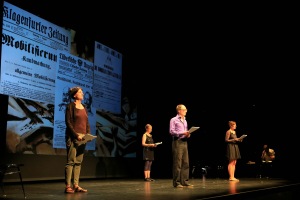
At the Off the Shelf Festival in Sheffield this year, Signposts organised a couple of poetry and music events, featuring a mixture of newly commissioned work and restagings of work from recent years.

This is a review of the first of these nights, 20 October 2009, which featured ‘Bat Detector’ by Elizabeth Barrett (words) and Robin Ireland (viola), and ‘Somewhere to Get to’ by Shelley Roche-Jacques (words) and The Only Michael (electronic sounds).

As will become obvious when you read the article below, I’m more interested in exploring how the poetry and music work together in performance here than in either the poetry or music on their own.

*

I first heard ‘Bat Detector’ on CD in 2007, when I played it on my radio show, but this was the first time I had heard it live. Then, as now, I felt there was something terribly restrained and even forced about the arrangement: the way that the viola and voice do not overlap at all, but are purely sequential. While part of me doesn’t like this very much, in the end I find it a powerful and moving piece, and full of tension, which is in part generated by the forced nature of its restraint.

The viola and the voice in ‘Bat Detector’ are not so much brought together, as forced to exist side-by-side, each enduring the other’s company, one waiting politely for the other to finish before taking its turn, then yielding again to the other. The form is stiff and Victorian, like a duet where the partners do not dance together, but instead take it in turns to dance, each waiting and watching while the other plays their part.

The text of ‘Bat Detector’ deals with blockages in communication. There is an autistic child, a difficult relationship, and the image of the bat detector itself, a box that allows us to listen in on the calls of other creatures we cannot understand, to hear sounds that we would normally be oblivious to. There is a sense that the worlds of other creatures, not just bats but also other human beings, are strange and obscure to us, and we can only listen in with wonder and curiousity. The bat detector, the medium of communication, is an instrument of delicacy, and there is something miraculous about it when it works.

The voice and the viola are rather like this. Two individuals, two different species, two different languages. The viola playing is precocious, irritating even in its desire to display its technical inventiveness and virtuosity. It scuffles about, seems to pick up on a rhythm, but then runs with it only intermittently, as if poor reception were causing it to cut out. You don’t feel the rhythm, but you feel like there is something else that does. And all this, somehow, seems to bear on the voice and its poetic content: there is the fluttering and screech of bats, the sense of a multitude of creatures, a fractured cloud of sounds that cannot be grasped individually, but which nevertheless impresses its mass upon you, and the rhythms of speech that somehow find their way into the music.

So, in holding apart words and music, as if to say, look, these are so different they could not possibly get on together, the poet and the violist actually allow the affinities between the two protagonists to emerge, and it is as if they would slam back into each other, were they not held apart with such force.

*

Perhaps one of the reasons for separating text and music in ‘Bat Detector’ was that each behaves as a soloist, demanding the full attention of the audience. They are two soloists without an orchestra. In ‘Somewhere to Get to’ this relationship is less clear. To begin with the music was extremely quiet, as if afraid of interfering with the voice and unsure of its own place in the performance. But then the volume surged, as if suddenly untamed, and threatened to drown out the ensuing poetry. It stepped back again, allowing the voice to come to the fore; but, having demonstrated its power, however quiet and submissive it got, from now on there was always the threat that it might surge again and overwhelm the voice. The music kept changing throughout, without any apparent continuity in rhythm or melody, and it was this unpredictability that I thought characterised it most.

In ‘Somewhere to Get to’ it was ultimately the words that held the piece together, the train of thought that holds its own against the concatentation of sounds swirling around it. The music, a mixture of samples, beats, and looped guitar, functioned more as a constantly moving backdrop, a series of imaginings that brought out the less stable content underlying the consistency of poetic style and delivery. It was rather as if we were on a journey through an urban environment, moving from space to space, where the various rhythms of work, conversation, machinery, and so on, keep changing. When the volume was low it was as if we were listening behind a closed door; then the door would open and we’d get flung forwards into the roar of traffic or rattle of a drill, so you could barely catch the words or hear yourself think.

Pick your own bilberries…and beat the minimum wage!

September 5th, 2009

When I set out to quantify in money terms the potential utility and remuneration for picking your own bilberries, I didn’t even expect to beat the minimum wage. I thought that picking your own bilberries would turn out to be a brazen act of self-exploitation, and that any self-respecting homo economicus would choose to hire cheap migrant workers to undercut themselves, thus freeing up their own labour time up for more profitable ventures.

However, this afternoon two of us picked around 3,000 bilberries in just one hour (with the jet-engine roar of a geothermal power plant in the background). That’s marginally over 800g. If bilberries sell for around £3 per 150g in the shops, then according to my calculations we earned ourselves about £8 per hour of bilberry utility.

And then there’s the benefit of being out in the fresh air and striking yoga-type poses on the hillside as you try to balance on the slope while reaching for those low-lying berries. Lets say the exercise and suppleness value-equivalent is two hours of yoga sessions at £6 per hour – and I’ve no idea how you monetise fresh air – that brings the total quantifiable utility of our harvest to £28, or a very respectable £14 an hour.

Of course, I’ve not included transport and fuel costs, which can apparently have a considerable impact on bilberry prices (read a detailed analysis of the relationship between fuel prices and blueberry prices here).

day 3, Nýhil International Poetry Festival

August 23rd, 2009

I sometimes get the feeling that geography plays a big role in the development of poetic style. I remember how in Sheffield, when we got people from other parts of the country in to perform at Spoken Word Antics, they often seemed like a breath of fresh air…not that it ever felt stale in Sheffield. That was the funny thing; you had a vibrant, diverse scene going on, and then someone would come along from outside and do something that was just self-evidently different from anything anyone in Sheffield would do. And that’s a bit what it was like at Friday’s poetry reading, day three of the Nýhil International Poetry Festival (Fimmta alþjóðlega ljóðahátíð Nýhils). There were ten poets, four of them from abroad, working broadly within what you might call the avant-garde tradition.

Dmitry Golynko, a Russian poet who is published in New York, read mainly in English, with a high-pitched incantatory tone that signalled a constant state of alarm. Even as he read in English his pronunciation (‘w’ as /v/, for example) and the melody of his voice seemed to transform many of the words back into Russian, so that the poems often had a liquid quality to them, melting back and forth between one language and the other. The repeatedly intoned line ‘weep it out’ in one poem sounded to my ears like the Russian ‘vypytaiut’, with its connotations of extortion and interrogation, and I struggled to remind myself that it was English. I can’t comment much on the content, but a lot of it seemed to address Kafkaesque (or Putinesque) state machinations, so this mis-hearing on my part wasn’t completely out of place.

UKON, a Swedish poet, used a lot of repeated sentence structures in his poems. One piece simply consisted of a long list of questions about ‘the father’, each question ending with the answer ‘nothing’.

What had the father bought for a Christmas present?
Nothing.
What did the father do for a living?
Nothing.

The effect of these accumulated negations of paternal responsibility, care, and agency was drastic, yet not entirely bleak, probably because there was an element of caricature implicit in the degree of exaggeration. The total rejection and alienation of the father seemed to reflect as much on the subject of the poem as on the father, suggesting that the inadequacies of the father have been passed on to the next generation. The lack of specification of who the father was and what the speaker’s relation to him was left the poem open, so that it could be interpreted at an intensely personal level or at an institutional level — the role, and implied failure, of fathers in society.

Another poem of UKON’s that impressed me was about age and height, and was largely made up lines of the type, ‘At the age of 8 I was 120cm. Two years later I had grown an incredible 34cm’. It went from birth right through to death at the age of 84, and clearly evoked those marks most families make on some spare wall or doorframe to chart the growing height of their children. All went as expected for the first three decades, with rapid growth through childhood and puberty levelling off. In the 40s the subject shrank slightly due to an illness — a bit earlier than one would expect, but still plausible. But from the 50s onwards the subject’s height departed from all norms, shrinking, then growing, then shrinking again to just half a centimetre, before doubling in size to one centimetre and increasing again by 1000%. In old age the subject’s height became extremely volatile, fluctuating from zero in one year to 34 metres in another.

The way that in late middle age the height took off, rather than shrinking, had a fantastic sense of elation to it, as if the subject had been emancipated from the rigours of aging. Perhaps this represents the emancipation of retirement or the loss of inhibition that some people feel around that age. The volatility during old age, on the other hand, evoked for me the uncertainty and physical insecurity of old age. I felt that height worked in the poem as a metaphor for the ego, or perhaps general confidence and wellbeing. Maybe the slight shrinkage in the 40s was the onset of a mid-life crisis.

In the second half we heard from two Danish poets, Mette Moestrup and Morten Søndergaard. Moestrup read a piece that drew on her time working in a hospital cafeteria when they were issued with skirts that were too short. The poem was all in Danish, but somehow it was very easy to follow, and the occurrence of words like ‘feminist’, ’sexist’, and ‘communist’ gave non-Danish speakers a pretty good idea of what was going on. I even found myself laughing in places, although though I couldn’t have told you exactly what was being said.

Morten Søndergaard finished the evening with a piece in which he tried to incorporate the ‘noise’ that you get when you open a file on the computer in the wrong programme — that jumble of unintelligible characters, yielding occasionally to strings of recognizable text. I always feel like I am being confronted, and affronted, with something when I see this, like seeing a mess of DNA code with an ear and some body parts floating about in it. Søndergaard’s method of rendering this noise in performance was through using his Kaoss Pad — an effects and sampler box, as far as I can work out — to modulate, distort, and screw around with his voice. This seemed like a pretty good audio equivalent; the noise in a file is language and formatting distorted by a computer, and the noise produced through his Kaoss Pad was also language (his voice) distorted through a computer.

He also performed it perfectly, managing seamless transitions between direct speech and the sampled sections, which nicely balanced being irritating, intriguing, and just a little bit amusing. The effects even provided some relief at the end of the poem, which consists of a large block of text something like this: ‘abbaaabba ggapp gabba baahba…’. He started reading this and my heart sank, —oh no, are we going to have to sit through a whole paragraph of this?! Then, just as I was about to become paralysed with despair, he started comically modifying the sounds he was producing, giving the whole thing a playful twist.

It’s harder to say much about the Icelandic poets because, with the exception of one (Kári Páll Óskarsson, I think), they spoke and read exclusively in Icelandic, and I’ve already gone on enough (in my previous post) about the excitement of listening to and miscomprehending poetry in a language you understand little of. I recognised Kristín Svava Tómasdóttir’s piece from the Summer Poetry Jam in May. It contains the phrases ‘Mr Brown’, ‘I am not a terrorist’, and ‘viltu pylsu?’ (‘do you want a hot dog?’), which effectively convey the thrust of what I take to be an angry and witty poem. I missed the line about the hot dog this time, but she made up for it with double-bass accompaniment.

I did wonder whether, in the international spirit of the Festival, all poets ought to be required to perform at least one poem in a language other than their own. Most of the visiting poets read in three languages — their own, Icelandic, and English — and I was struck by how comfortable they seemed be with their poems in translation. Maybe that is something that poets in non-English languages have to live with a lot more — seeing their poems alive in different languages, and not thinking of translations as second best, but as another manifestation of the poem, another part of its life. It’s all part of the process of letting go, which happens the moment you publish or perform your work, but even more so when you let someone else render it into a different language for you.

fragmented thoughts and unexpected collisions (open mic at the Nýhil International Poetry Festival)

August 20th, 2009

At last, some live poetry! The Nýhil International Poetry Festival is upon us, and yesterday was night one, the open mic/michelle. I hadn’t been to any live poetry events since May, and last night I realised how much I’ve been missing it.

I read about the event on the Nýhil blogspot, and worked out that it was one poem each (in spite of being an ‘international’ festival, there’s been very little information available in English about it), but hadn’t realised that you were also supposed to read one poem by someone else too. So when it came to my turn, just like on Who Wants to Be a Millionaire?, I decided to text a friend, and was able to read out this haiku by Matt Clegg, direct from Sheffield:

A lone cobweb hangs
from the campsite tap — supports
one obese droplet.

I think it’s from ‘Trig Points’, which you can listen to on the Spoken Word Antics Sound Archive.

I also read ‘Shelter’, a poem of mine about a woman in a strange land who can’t speak the language trying to find her way. It reminded me of how I feel myself here sometimes, although the big difference is I can always open my mouth and speak English, which the woman in the poem can’t.

The running order was anarchic in logic – people just got up to read when they felt like it – but not in style; maybe a certain ease comes from people choosing their own moment…although I did occasionally notice those with less self-awareness prevailing over those with more.

Some I could understand, some I couldn’t; there was an English translation, which we were assured was nothing like the original, a rather un-hip rap (the kind where the words are forced into a rhythm, rather than written with rhythm in them), a poem from the milk carton, one neurotic piece that reminded me of the landlady from hell we narrowly escaped committing to a few months ago, and an interminable tract of social theory (the spectator, media, hegemony…Baudrillard perhaps?) that had us all feeling much enlightened once it was finally over.

All those words, all those people with things to say; one glorious, eclectic jumble of articulation and, on my part, much miscomprehension (but serendipitously so). Here is a rough approximation of what’s going on in my head when I’m listening to poetry in Icelandic:

‘Hvað sem ég er, í bílinum, reyking í geymsla…smoking in the cellar, or is that an invoice, something about a car, and what is it that I am?’

As you can see, it doesn’t make a lot of sense, but there is something wonderful about the combination of images and words, the fragmented thoughts, and unexpected collisions. I’m often not very good at paying close attention to what I’m listening to anyway. If I’m really enjoying a piece of music or poetry, it’s often because it’s stimulating my thoughts; my mind may be somewhere completely different, though still working in parallel to the performance and in some way guided by its structure, its shifts and moods. Listening to something you can only fractionally understand could be seen as a liberating aesthetic experience, because it frees you from any obligation to pay close attention, while a residual structure comprised of tone of voice, rhythm, sound texture, intonation, and so on – everything that is left when you take away the words – keeps you connected.

A RepRap world is possible

August 12th, 2009

How about this, the RepRap, a machine that can produce all kinds of useful household objects, and can also reproduce itself:

RepRap from Adrian Bowyer on Vimeo.

The people behind it aim to have one in every home, but just one in every community would potentially be sufficient as a seed for non-capitalist production, because:

  1. The RepRap technology can overcome the separation of producer and consumer that characterises commodity production. If people produce what they or people in their community want, then production is driven by concrete demand (use values) rather than abstract demand (exchange values).
  2. It puts the means of production back in the hands of producers. If capitalists no longer have a monopoly on the means of production, then the fundamental distinction between capitalists and workers underlying capitalist society is broken down.

Of course it’s the pattern of production that is important. If this technology can only ever produce a small range of useful items then it’s not going to make much of a difference, but if it can be replicated in many spheres of production then it will have a significant impact.

The technology also relies upon raw materials (plastic, metal), and if the production of those materials remained in capitalist hands then its socio-economic effect might also be severely compromised.

Now I wonder, what, apart from coat hooks, might you be able to produce with this machine?

how to make a really nice curry

June 9th, 2009

Yes, it’s cookery school time! What could go wrong? – You could burn the garlic, overdose on asafoetida, get bits of coriander seed stuck in your teeth, and end up chewing on a raw potato…or you might find yourself marvelling at something approaching the golden yellow, crispy, succulent, sweet fragrant dish I discovered I’d made earlier. I’m told it had a hint of currywurst, but without the wurst, and suitable for vegans. You can serve it with rice, but maybe just a bowl on the side because it really doesn’t need much. Probably feeds four.

The Materials
2 onions, chopped into eighths
10 small (but not tiny) red potatoes, peeled
the larger half of a cauliflower
1 green pepper, cut into strips
6 cloves of garlic, maybe more
light olive oil
1/2 tin of coconut milk
rice

spices
ground turmeric
ground hot paprika
ground asafoetida
black peppercorns
cardamon pods
coriander seeds
fenugreek seeds

The Method
There are four things to do here, and they all need doing at the same time, so don’t do one after the other, do them all at once – be a whirlwind of culinary activity, impress your friends, post the pictures to facebook, show the world that you have produced something. Now, back to the recipe.

  1. we’re going to par-boil the potatoes and cauliflower here, before we roast them – that way the potatoes don’t take ages to roast while everything else burns, and the delicate cauliflower gets less rough handling; give the potatoes 10 minutes, then the cauliflower 7; when they’re done, cut the potatoes into roasting-size chunks (quarters or fifths), and cut the cauliflower into florets or attractive-looking chunks
  2. meanwhile, set the oven to 220C and get the other vegetables roasting; the onions and green peppers probably need a 10-minutes headstart, then add the potatoes, then the garlic (at least 5-7 mins later), and then the cauliflower – make sure the onion is properly cooked before adding the cauliflower, as the increased bulk will reduce the cooking speed; give the vegetables a stir every 5-7 mins so everything gets a little bit of oil and radiant heat (and add more oil if necessary), but always return the dish to the oven as quick as you can so it doesn’t lose heat and momentum
  3. meanwhile again, while the vegetables are roasting, get your spices ready: toast the coriander, fenugreek, and black pepper in a dry pan on a medium-high heat till they start to release their aroma and begin to turn golden – take care not to burn them; crack open the cardamon pods and mix the seeds in a mortar with the toasted spices and grind them, then add the other spices; sprinkle the spice mix over the vegetables, stir, and return to oven – I did this after having added the cauliflower, but you could do it earlier…probably not before the potatoes are in though, because you don’t want the spices to burn
  4. meanwhile again again, cook the rice; you could use the water the potatoes and cauliflower were cooked in for extra flavour and goodness
  5. finally, when the spices and everything are in and definitely cooked, chuck in the coconut milk, stir, and give it a few more minutes; that way you get a bit of sauce to go with your crunch

The Erosion of Use Value

June 5th, 2009

I went to Kringlan today to get a wooden spoon to use for making cakes and tarts, so dessert doesn’t end up tasting of curry and garlic, and ended up with a medium-sized specimen for Kr 300 that seemed to combine in the best way available the qualities of durability, utilitarian looks, and affordability. So I’ve added that to my Consumption Fund, and because the initial outlay was so minute I didn’t even need a loan to finance the purchase. The Consumption Fund, by the way, comprises commodities that

are not consumed directly but serve as instruments of consumption. They include items as diverse as cutlery and kitchen utensils, refrigerators, television sets and washing machines, houses, and the various means of collective consumption such as parks and walkways. All such items can conveniently be grouped together under the heading of the consumption fund. [David Harvey, The Limits to Capital (London: Verso, 2006), p.229]

After all that shopping I wanted a tasty morsel to speed me on my way, so I popped into Hagkaup and bought myself a cheesy pastry type thing. I was really looking forward to my cheesy pastry, so I popped it into the top pocket of my panier bag, which I left unzipped for convenience because, after all, I wasn’t going far, and went in search of a quiet grassy spot to enjoy my lunch. Then suddenly the bike felt lighter and I had an awful premonition. I turned my head to check the pastry was still there. It can only have weighed a few grams but the bike felt lighter, and when I turned my head the pastry was gone.

I went back to search for it, in case it had landed somewhere clean, or maybe just to assess the situation and work out exactly where things had gone wrong. I found it lying on the tarmac in the middle of the entrance channel to Kringlan car park. A car drove over it, but the wheels went around it and it wasn’t squashed. Two birds hopped around, pecking at the flaky crumbs. And there I was confronted with the sudden, catastrophic erosion of use value. Something that had been useful a moment ago had, without undergoing any substantial change to its physical state, had its total utility eroded in a flash. It was like seeing a boll of ice cream that’s toppled off its cone, and I was the child that had been holding the cone.

Hardt and Negri – it’s immaterial

May 27th, 2009

I’ve just been to a lecture by Michael Hardt and Antonio Negri at the University of Iceland. I was particularly interested to hear them speak as I read an article by Slavoj Žižek the other day in New Left Review in which he borrows from Hardt and Negri their concern with the commons. He talks about ecology, intellectual property rights, and bio-technology as the sites of three of the main antagonisms of contemporary capitalism, and characterises these three antagonisms as issues of the commons. The enclosure and expropriation of the commons is a common thread running through the history of capitalism, linking 18th-century England and modern China, and one that is familiar and well-established, so it seems an effective way of understanding and connecting the politics of these antagonisms Žižek describes. The external environment, culture, nature, and the internal environment (the body) are all common resources that are under threat of being enclosed, exploited, expropriated, and even destroyed for private gain.

For me the most interesting part of Michael Hardt’s talk was probably his distinction between material and immaterial property. I wasn’t exactly sure what was meant by immaterial property, probably because there was a TV camera about two feet away pointing right at me while he was on this topic, and this rather affected my ability to concentrate. Something to do with producing wellbeing, communication, software, knowledge, presumably organisation as well, that kind of thing. He compared this distinction to the distinction made by Marx between mobile and immobile property. Immobile property is, of course, chiefly land, while mobile property refers mainly to industrial products. Hardt proposes that the main distinction between different types of property is now that of material versus immaterial.

The distinction between immobile and mobile property corresponds to that between land and capital, and to the social distinction between the aristocracy and the bourgeoisie. These were two social classes, two ruling classes indeed, one established, the other in the making. Sometimes they worked together, at other times, as in the French Revolution, they were in opposition to each other. How do the concepts of material and immaterial property map onto our social structure, I wondered, are they supposed to correspond to different factions in the ruling class in the same way as mobile and immobile property? We often talk about the ruling class being divided between the interests of finance capital and industrial capital, and I suppose that finance probably counts as an immaterial product, but I’m not sure how the interests of the owners of call centres, educational institutions, software houses, and so on differ significantly from the owners of material industries.

But it was not so much the ruling class as the conditions of the workers that Hardt seemed to be getting excited about. In immaterial industries, he claims, workers have a greater degree of freedom or power than their counterparts in material industries, and – this is the important bit – a greater opportunity (and perhaps propensity) to embark upon a liberation struggle…this was one of the points where I lost concentration – maybe it was the camera, or maybe it was just a little bit woolly – but that’s the gist of it anyway. So the development of immaterial property (I’m not sure if material property plays much of a role other than to help define immaterial property) offers us a window of opportunity for overcoming capitalism.

Antonio Negri read his lecture in Italian with Icelandic surtitles, and I decided that, even halfway through Icelandic for foreigners level II, I’d probably understand more in Italian, so I closed my eyes and listened. I learned Italian when I was 18 and travelling in Italy for three weeks on an inter-rail pass, so, as you can imagine, I didn’t learn very much Italian. I do remember, however, being amazed at how much I could understand. Sometimes people started talking to me and I understood pretty much everything they said. I didn’t know whether it was to do with the proximity with French or Latin (I’d learnt Latin for three years at school then promptly forgotten everything except hic, haec, hoc, eram, eras, erat, and huius, huius, huius…but maybe some of it was still rattling around my subconscious), but Italian felt like it was a natural language, like it was somehow already within me, and I only had to rediscover it, like exercising some neglected muscle. So I closed my eyes tonight and thought, ‘maybe, maybe I can do it again’.

And I understood a surprising amount. I wasn’t able to follow any arguments, but I could tell most of the time what he was talking about and recognised a few phrases, like ‘production of subjectivity’ (in Italian, of course, but it only works one way so I can’t repeat the Italian). I even picked up a bit of Icelandic. Samstoða means ’solidarity’, and sjálfsemd ‘identity’ (I think).

Oh, and I think it was organised by Nýhil (yes, the poetry group, but they evidently do more than just poetry).